Honeywell Is a Growth Company Again as It Taps the Power of Big Data
Delight take annotation this is only one aspect in weighing the bewitchery or non-attractiveness of the companies mentioned as an investment and should not exist used contained of other factors. This article examines i segment of the companies' businesses, and other factors such equally valuation are non addressed. This article is not a recommendation to purchase or sell whatever stock mentioned.
Honeywell (NYSE:NASDAQ:HON) is ramping up its software capabilities and coupled with its assortment of aircraft hardware, the company is in a expert position to do good from the era of " connected shipping".
The B2B market for IoT is poised for growth. Terminal year, there were ii.four billion continued devices being used by businesses, and this year there will be iii.1 billion, co-ordinate to Gartner, the research grouping. By 2020, it expects that number to have more than doubled to vii.half-dozen billion.
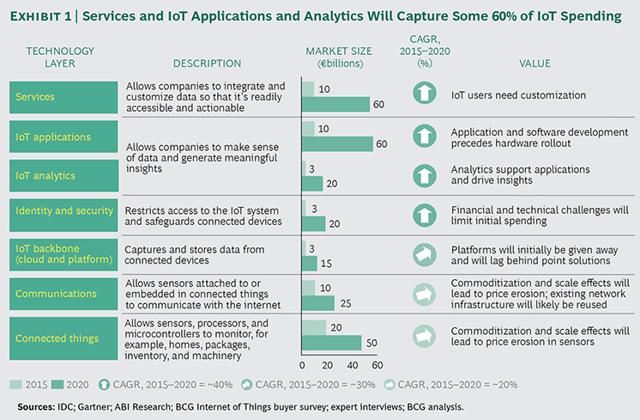
By 2020, companies will spend an additional € 250 billion on IoT (over and above their normal technology spending).
The IoT market has several layers and just the top two layers of the technology stack, namely services, and IoT applications and analytics, are expected to see the biggest growth and capture the bulk of IoT spending.
Source: Boston Consulting Group
This could explain why industrial companies have been ramping upwardly software capabilities, spending billions in the process. Siemens (OTCMKTS:OTCPK:SIEGY) has spent $fifteen billion on United states of america software companies since 2007 and has 21,000 software engineers. High german engineering giant Bosch has more than twenty,000 software engineers, of which 4,000 are focused solely on the internet of things. GE (NYSE:GE) has 14,000 software engineers and is planning to hire vi,000 more technical and support staff for its digital operations.
Honeywell has also focused on software in an effort to capitalize on this digital shift. Half of the company'south engineers are dedicated to developing software. The company'southward new CEO wants to invest in software capabilities to drive growth. Software is a growth opportunity for the company; HSBC Global estimates that stand-alone software products will account for roughly 22% of total sales by 2020, more than double the level in 2015.
Of Honeywell'southward 4 operating units, aerospace, one of its highest margin divisions, is the largest, accounting for 37% of revenue and 40% of turn a profit. While IoT-based "connected cars" have been making headlines, Honeywell has positioned itself in aviation IoT by offer software services for "continued shipping" with its big data-driven software solution Go Directly which is a suite of more than than fifty continued shipping services which includes solutions for cabin connectivity, flight support services, fuel efficiency services and predictive maintenance.
The company demonstrated its array of connected shipping technologies when it conducted a worldwide tour of its "Connected Aircraft" this year.
While the company's Go Direct software exposes Honeywell to several areas of the "connected aircraft" opportunity, the exposure to predictive maintenance, which leverages on Honeywell'south position equally a top supplier of shipping equipment, could be a peculiarly assisting opportunity.
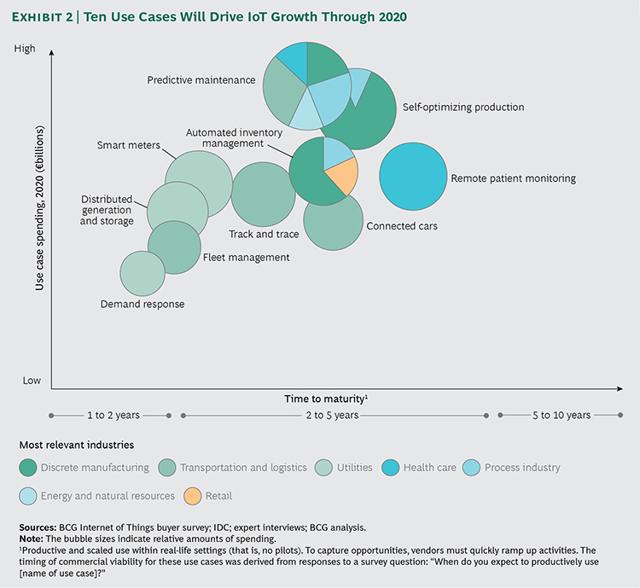
Among the many employ cases for B2B IoT, predictive maintenance is expected to be a major growth driver.
Source: Boston Consulting Grouping
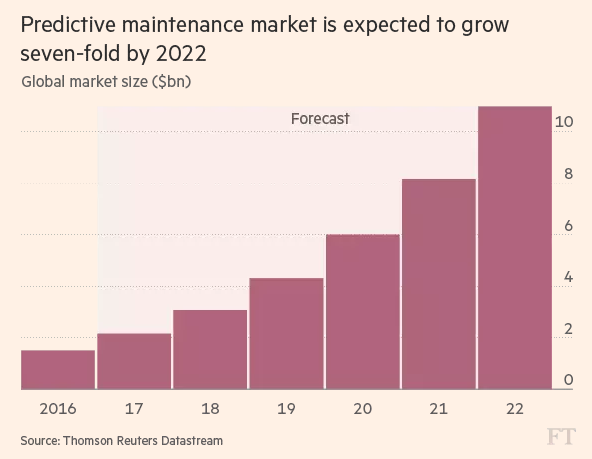
Predictive maintenance is expected to abound seven-fold by 2022.
Source: FT.com
Ceremonious aviation is one of the most asset-intensive industries in the world. Even the slightest improvements in nugget functionality and maintenance (notably by reducing fuel costs and maintenance costs) can yield substantial price savings.
For example, the Airlines for America (A4A) manufacture trade association collected financial data for nine U.S.- based carriers - United (NYSE: UAL) , American (NASDAQ: AAL), Delta Air Lines (NYSE: DAL), Southwest Airlines (NYSE: LUV), Alaska Airlines (NYSE: ALK), JetBlue (NASDAQ: JBLU), Hawaiian Airlines (NASDAQ: HA), Spirit Airlines (NASDAQ: Salvage) and Allegiant (NASDAQ: ALTG) — and found they collectively reported a pre-tax profit margin of 11.four% ($ix.2 billion) for the start half of 2017 which is down from a collective 15.5% pretax margin ($12 billion) during the first half of 2016. The reason for the pass up was due to a "surge" in expenses in the first one-half of 2017, which outpaced revenue growth. The biggest increases in expenses were from fuel costs, labor and maintenance.
Record depression oil prices, capacity discipline and increasing demand for air travel have helped airlines reach record profitability for their fifth consecutive year, according to PwC. To sustain this growth, airlines can implement additional measures to improve operational efficiency past cutting costs and improving reliability.
For airlines, cancellations and delays are a huge and expensive problem. Up to xxx% of the total delay time is due to unplanned maintenance, hence predictive maintenance solutions which take reward of IoT, are a compelling business example for the airline sector. Final year, in the U.South. alone, the price of maintenance related delays was well over one-half a billion dollars.
Leveraging on its existing install base of aerospace hardware such as brakes, wheels, APUs and sensors, Honeywell has an opportunity to plant a position for itself in the promising predictive maintenance market place. Honeywell has an array of aviation and aircraft components making it one of the height aerospace companies in the world.
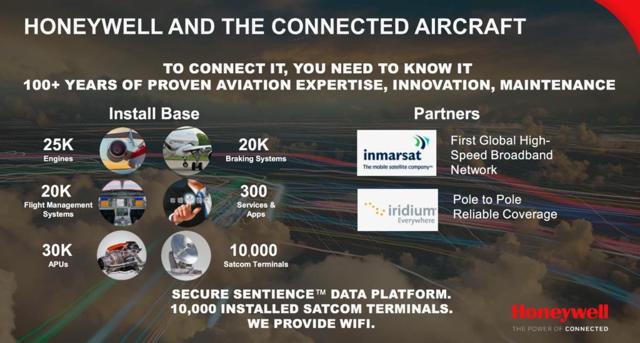
Honeywell dominates the market for Auxiliary Power Units (APU) with a 76% market place share for commercial aircraft. Its market share in military and individual planes is even higher. An APU, a critical component of an shipping fabricated by companies such as Honeywell and Hamilton Sundstrand (NYSE:UTX), is a small gas turbine engine which provides electrical power for starting an aircraft'due south chief engines and runs air conditioning and other systems while the plane is on the ground.
In 2009, when a United states Airways A320 flying that had just departed New York's LaGuardia drome struck a flock of geese, both of the shipping's GE Aviation/Snecma-designed CFM56 turbofans were damaged and the associated electrical controls malfunctioned. It was the APUs during the final seconds that came to the rescue, providing the ability needed to keep the flight controls, displays etc performance to permit the pilot to bear upon down in the Hudson River.
In May this twelvemonth, Hainan Airlines China's largest privately-operated airline, became Honeywell's first customer for its data-driven MRO (maintenance, repair, overhaul) service. Honeywell signed a deal with Hainan to provide predictive maintenance for Hainan Airlines' current fleet of 50 Airbus A330s as well every bit xl more A330s when they are delivered in the future. Honeywell'due south Go Straight Connected Maintenance volition exist used to support auxiliary ability units (APUS) by collecting APU information which will exist used to predict possible issues and thereby reduce reanimation.
Later the Hainan Airlines deal in May, the post-obit month, Honeywell won a contract to provide predictive maintenance for Cathay Pacific A330s. Honeywell's Get Direct Connected Maintenance plan volition be outfitted on more than than sixty of Cathay Pacific's and Cathay Dragon's Airbus A330s. Prc Pacific had been using the technology in a trial program which proved it can reduce inoperative systems by upwards to 35%, cutting maintenance and operation costs amounting to several hundred thou dollars, reduce delays (APU-related delay minutes were reduced by 51%) and aircraft reanimation.
Building on this early on-stage success, Honeywell is now eyeing the prospect of carving a bigger piece of the predictive maintenance market by broadening the scope of its Go Direct Maintenance services to other components (such every bit wheels, brakes and environmental control systems) including not-Honeywell components.
To conclude, the B2B IoT marketplace is growing. A report by London-based research firm Techanvio expects aviation IoT to grow to U.s.$ xiv billion by 2021 from about United states$ 6 billion in 2016, representing a CAGR of 19% betwixt 2017 and 2021. According to the firm, the prime number driver propelling airlines to upgrade to IoT-enabled systems and architecture is to improve efficiency and reduce operational expenses. As a leading supplier of aerospace components and equipment, this is a growth opportunity for Honeywell, which derives over one-third of its total acquirement from its aerospace segment which amounted to US$ 3.67 billion in the second quarter of 2017 with a turn a profit margin of 22.3%.
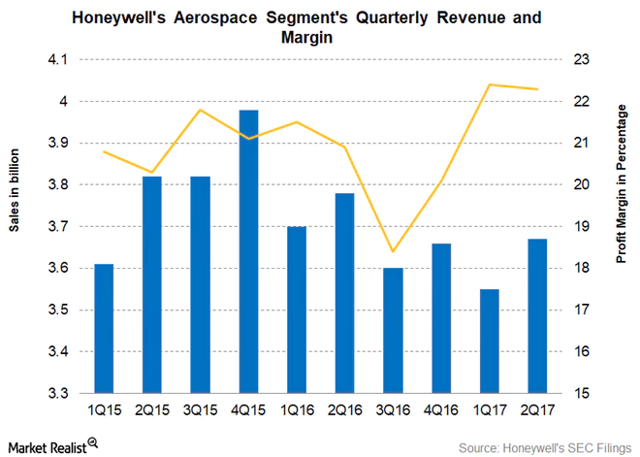
To tap the opportunity, Honeywell has been expanding its software capabilities and with its Go Directly software, the company offers a suite of technologies for the era of "connected aircraft".
Predictive maintenance is a promising growth surface area, and this is peculiarly applicable to the airline manufacture where fuel and maintenance are two of the biggest operational expenses. Leveraging on its wide install-based of aircraft components, Honeywell has the opportunity of carving a new acquirement stream by offering big-information driven predictive maintenance services for its array of aircraft components.
Honeywell's Become Direct fuel efficiency software has too constitute success, bagging two new clients in August this year - Brussels Airlines and Air Serbia. The software uses information analysis, reporting and monitoring tools to place fuel saving opportunities that make flying more than toll-efficient, for example, past communicating flight efficient paths to pilots. 20% - forty% of an airline'southward operating cost is associated with fuel expenses. These ii airlines bring together a list of over 30 airlines using the software including Jet Airways, Lufthansa (OTCQX:DLAKY), Etihad, Finnair, Japan Airlines and Turkish Airlines.
Going forwards, at that place is potential for margins in Honeywell'southward aerospace segment to better, driven past the growth of connected shipping which offers an opportunity for the company to add scalable software solutions to its existing install base of shipping hardware. Higher software sales could accept a particularly favorable impact on margins.
This article was written by

Long only, focused on loftier quality businesses with economic moats and solid business fundamentals. Sector and geography agnostic. Long term investment horizon. None of the articles constitute investment advice.
Disclosure: I/we take no positions in whatsoever stocks mentioned, and no plans to initiate any positions within the side by side 72 hours. I wrote this article myself, and it expresses my own opinions. I am non receiving compensation for it (other than from Seeking Blastoff). I accept no business relationship with any company whose stock is mentioned in this commodity.
Source: https://seekingalpha.com/article/4100633-honeywell-positioning-for-connected-aircraft-opportunity

Post a Comment for "Honeywell Is a Growth Company Again as It Taps the Power of Big Data"